
Day Three in Dallas: Prevention, Preparation, and Stronger Investigations
Day Three in Dallas: Prevention, Preparation, and Stronger Investigations
Day Three of the Crimes Against Children Conference in Dallas brought another full day of specialized training for the West Georgia team. Sessions focused on child abuse investigations, forensic interviewing, online exploitation, trafficking, prevention, courtroom preparation, survivor support, and multidisciplinary teamwork.
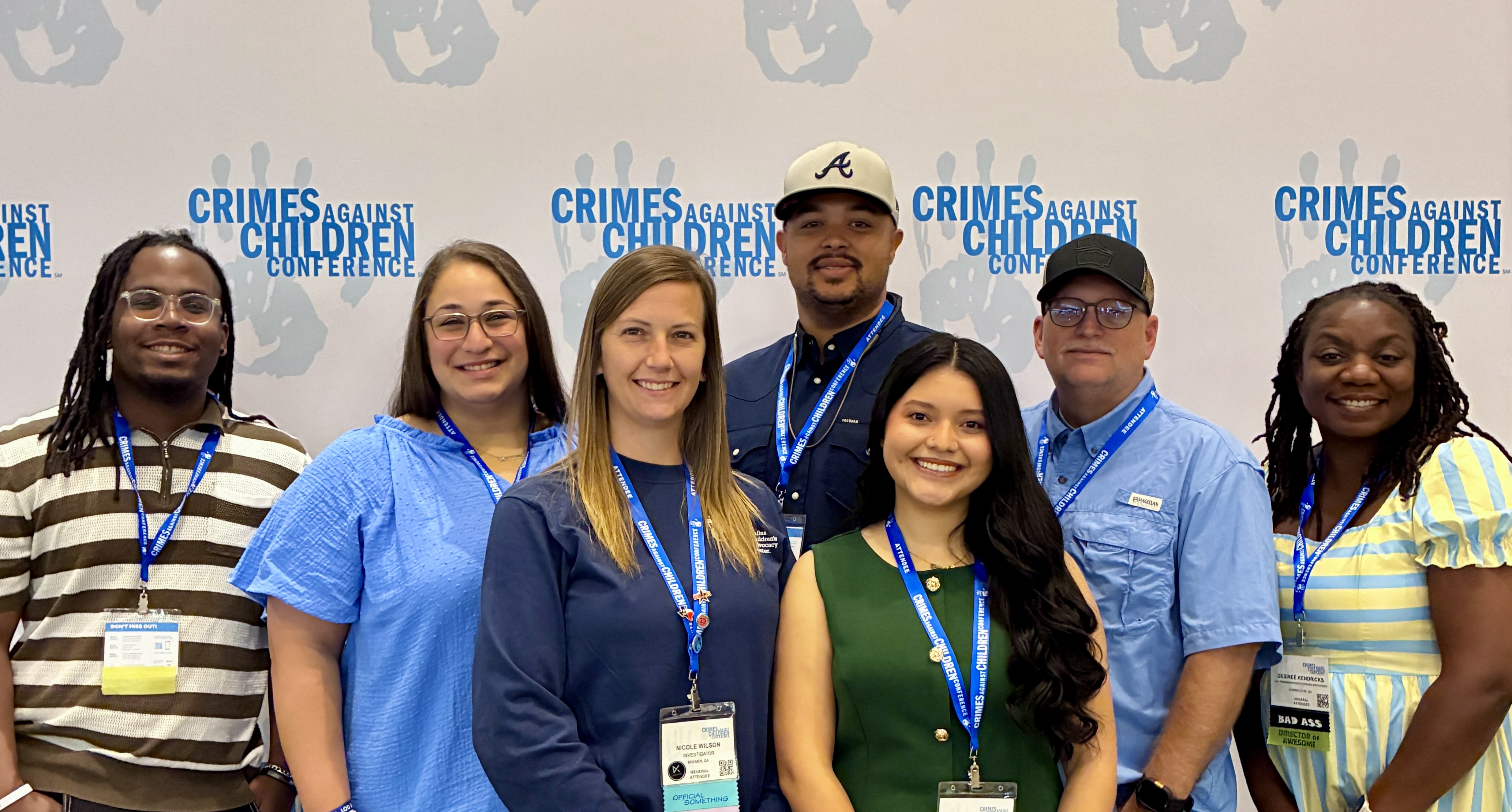
Representatives from the West Georgia Child Advocacy Center, Haralson County Sheriff’s Office, Carrollton Police Department, and Bremen Police Department followed training tracks connected to their professional roles while identifying practical strategies they can bring home to better protect children and support families.
Across the day’s workshops, one message remained clear: an effective response requires both strong investigations after abuse is disclosed and meaningful prevention before harm occurs.
From Outcry to Conviction
Brad Richards and Dalton McKinzie of the Bremen Police Department, Halle Rosen of the Carrollton Police Department, and Nicole Wilson of the Haralson County Sheriff’s Office attended a two-part training examining how investigators can build a case beginning with a child’s initial disclosure.
A child may disclose abuse immediately, months later, or even years after it occurred. Each type of outcry creates different investigative opportunities and challenges.
Immediate disclosures may provide opportunities to recover physical or digital evidence, obtain medical findings, and quickly identify witnesses. Delayed disclosures are also common, but they may be misunderstood because physical evidence and historical witnesses can be more difficult to locate.
Halle emphasized the importance of understanding the circumstances surrounding each disclosure.
“The outcry is where it all begins.”
Children may disclose during therapy, at school, during a medical appointment, to a caregiver, to a friend, or through social media. Investigators must carefully evaluate the context of the disclosure without labeling it as “good” or “bad.”
Brad focused on adapting the investigation to the timing and type of outcry, while Nicole examined why children may wait to tell and how investigators and prosecutors can continue building a case despite that delay.
The sessions reinforced that there is no single “correct” timeline for a child to disclose abuse.
Corroboration, Recorded Calls, and Courtroom Preparation
The second portion of the training examined evidence-based case building, suspect interviews, recorded calls, courtroom testimony, and techniques for corroborating a child’s account.
A recorded one-party consent call may provide important evidence in a case with limited physical findings. Even when a suspect does not give a full confession, the person may acknowledge being present, confirm a location, apologize, discuss a significant detail, or fail to deny an allegation.
Dalton reflected on the value of these investigative tools.
“One-party interviews can play a major role in adding significant evidence to the case and validating statements made by others.”
The law enforcement team also explored suspect-interview strategies designed to encourage continued communication and obtain additional information. The sessions addressed techniques such as normalization, carefully framed minimization, and positive reinforcement following an admission.
Halle noted that even evasive responses or partial acknowledgments can become important pieces of the case.
Nicole and Dalton also focused on courtroom preparation, evidence processing, testimony, and clearly explaining investigative decisions. Dalton noted that continued training on testimony is particularly valuable for officers who regularly participate in court proceedings.
The training reinforced a lesson repeated throughout the conference: strong cases are often built through many carefully documented pieces of evidence rather than one dramatic finding.
Bringing Online-Safety Education to West Georgia
Brad, Halle, Nicole, and Dalton also attended a presentation from the Department of Homeland Security’s Know2Protect campaign.
Know2Protect provides resources for children, teenagers, caregivers, schools, and communities to recognize and prevent online child sexual exploitation.
The presentation emphasized how quickly an online interaction can become unsafe.
“It takes 19 seconds for a conversation to turn dangerous.” — Halle Rosen
The team learned about school-based and peer-to-peer programs that teach young people how to recognize grooming, respond to inappropriate requests, protect personal information, and seek help from a trusted adult.
Brad and Dalton spoke directly with campaign representatives and obtained contact information for the Georgia liaison as the team explores opportunities to bring Know2Protect programming to West Georgia schools.
Nicole recognized the immediate value of providing children and caregivers with practical internet-safety education.
“There are programs that we can bring in to provide children with education on internet safety and prepare them if someone tries to sexually exploit them.”
For Dalton, the session reinforced the importance of reaching young people before exploitation occurs.
“The most important thing I learned today was investing in youth as early as possible.”
Educating children about online risks does not place the responsibility for preventing abuse on them. It gives children accurate information, practical safety tools, and trusted adults they can turn to when something feels wrong.
Strengthening Forensic Interviews
Desireé Kendricks and Mariana Reyes of the West Georgia Child Advocacy Center continued strengthening their forensic interviewing skills through sessions on alternative hypotheses, child development, questioning techniques, trafficking, suggestibility, and survivor experiences.
Desireé’s training emphasized the importance of testing alternative explanations and avoiding tunnel vision during child abuse interviews and investigations.
“Prioritize hypothesis testing and continue to work with your MDT during challenges.”
Exploring alternative hypotheses does not weaken a case. It helps forensic interviewers and investigators demonstrate that they considered the available information carefully and did not begin with a predetermined conclusion.
Desireé and Mariana also attended training on the use of who, what, where, when, and how questions in child interviews.
Concepts that appear simple to adults may be abstract or confusing for children. Desireé noted that children around seven or eight years old may struggle with questions involving time, particularly when asked whether something happened “before” or “after” another event.
Mariana focused on distinguishing between concrete and abstract questions and maintaining a pace and rhythm consistent with the child’s developmental level and language.
Interviewers must continually assess whether a child understands what is being asked. Rephrasing, clarifying, and using developmentally appropriate language can reduce confusion without introducing new information or leading the child.
Interviewing Children Who Have Experienced Trafficking
Several members of the team attended training on forensic interviews involving children and teenagers who have experienced sex trafficking.
These interviews require preparation, patience, flexibility, honesty, and an understanding that a young person may not identify as a victim.
Desireé noted:
“Often, these individuals do not see themselves as victims.”
Trafficked children may experience manipulation, threats, violence, coercion, emotional dependence, or loyalty to the offender. These factors can create significant barriers to disclosure and affect how a child understands the exploitation.
Brad focused on identifying those barriers and learning strategies that can help investigators and interviewers respond appropriately.
Nicole examined the preparation, services, and long-term support needed after a child has been brought to safety. Recovery does not end when the immediate danger has passed. Children and families may need ongoing advocacy, mental health services, medical care, legal support, education, housing assistance, and safety planning.
Halle and Dalton also valued learning how federal investigators approach trafficking interviews. For Dalton, the session provided a broader understanding of the process beyond the law enforcement investigation alone.
Strengthening Interviews Through Research
Desireé also attended a session on defending forensic interviews from claims of suggestibility.
The workshop reviewed research that may be raised during court proceedings and helped forensic interviewers better understand how to explain the structure, purpose, and reliability of their work.
Her sessions built upon one another—from testing alternative hypotheses and avoiding tunnel vision to improving questioning techniques, interviewing trafficked teenagers, and understanding suggestibility research.
“Today, I feel as if all the sessions built off one another.”
This type of continuing education is essential because forensic interviewing practice continues to evolve alongside research, court decisions, technology, and a growing understanding of child development and trauma.
Prevention Through Healthy, Age-Appropriate Conversations
Mariana and Dorien Lee of the West Georgia Child Advocacy Center attended sessions examining the cultural, developmental, and educational issues that can increase children’s vulnerability to abuse.
Mariana’s training explored the intersection between human sexuality and child sexual abuse and the importance of helping caregivers have healthy, age-appropriate conversations about bodies, boundaries, development, and physical responses.
“We can combat this by empowering and encouraging parents to have healthy, age-appropriate conversations with their children.”
Children may experience physical responses to unwanted touch, and those responses do not mean that the child wanted, invited, or enjoyed the abuse. When adults avoid these subjects because they feel uncomfortable or taboo, children may be left confused or ashamed.
Accurate, age-appropriate education can give children appropriate language, reduce shame, and create a safer environment for asking questions or reporting concerns.
Mariana also attended training on problematic sexual behaviors in children and the distinctions among pedophilic, hebephilic, and ephebophilic interests. Her takeaway emphasized the importance of caregiver involvement and informed intervention when children exhibit concerning sexual behaviors.
Dorien’s training examined how pornography and increasingly sexualized media can adultify children, normalize harmful behavior, blur boundaries, and make young people more vulnerable to grooming.
“Modern culture is adultifying and pre-grooming children for their abusers.”
Together, these sessions reinforced that avoiding difficult conversations does not necessarily protect children. Trusted relationships, accurate information, clear boundaries, informed caregivers, and strong youth-serving organizations can help reduce vulnerability.
Supporting Survivors Beyond the Investigation
Mariana and Dorien also participated in survivor-centered sessions examining the lasting effects of abuse and exploitation.
Mariana attended a two-part presentation focused on a survivor’s experience of abuse and its aftermath. The session reinforced that children should never be viewed only as witnesses or sources of evidence. They are individuals who need dignity, safety, support, and opportunities for healing throughout and beyond the investigative process.
Dorien attended a session examining justice, restitution, and recovery for victims whose sexual abuse images remain online.
“Victimization for many child sexual abuse victims does not end with the arrest of the perpetrator.”
Each time abusive material is viewed, downloaded, or redistributed, survivors may experience renewed harm and the knowledge that the images remain outside their control.
Dorien also learned more about resources available through the National Center for Missing & Exploited Children for survivors and families navigating the continuing effects of online exploitation.
His additional training examined collaboration during difficult cases and the importance of identifying weaknesses in child-protection policies. These sessions provided practical strategies for helping organizations move from research and recommendations to concrete safeguards while keeping multidisciplinary partners focused on their shared responsibility to protect children.
West Georgia Is Learning Together
The West Georgia delegation includes:
Desireé Kendricks, Mariana Reyes, and Dorien Lee
West Georgia Child Advocacy Center
Nicole Wilson
Haralson County Sheriff’s Office
Halle Rosen
Carrollton Police Department
Dalton McKinzie and Brad Richards
Bremen Police Department
Each participant followed a training track connected to their role, allowing the team to gain knowledge across investigations, forensic interviewing, advocacy, prevention, digital safety, trafficking, policy, and survivor support.
Bringing Day Three Home
Day Three was about more than collecting information. It was about identifying practical opportunities for action.
Although participants followed different training tracks, the lessons repeatedly connected. Prevention education can reduce vulnerability and help children recognize unsafe behavior. Skilled forensic interviews help children communicate in ways that are accurate and developmentally appropriate. Thorough investigations strengthen prosecutions. Informed caregivers reduce shame and create safer opportunities for disclosure. Effective multidisciplinary teamwork helps ensure that children and families receive a coordinated response.
The West Georgia team is returning with stronger strategies for investigating immediate and delayed disclosures, improved preparation for recorded calls and courtroom testimony, new approaches to trafficking cases, better questioning techniques, additional online-safety resources, and a renewed commitment to survivor-centered collaboration.
The team is also exploring opportunities to bring Know2Protect programming to local schools and communities.
West Georgia is showing up in Dallas—and preparing to turn what we are learning into stronger prevention, better investigations, more informed interviews, and greater protection for the children and families we serve.